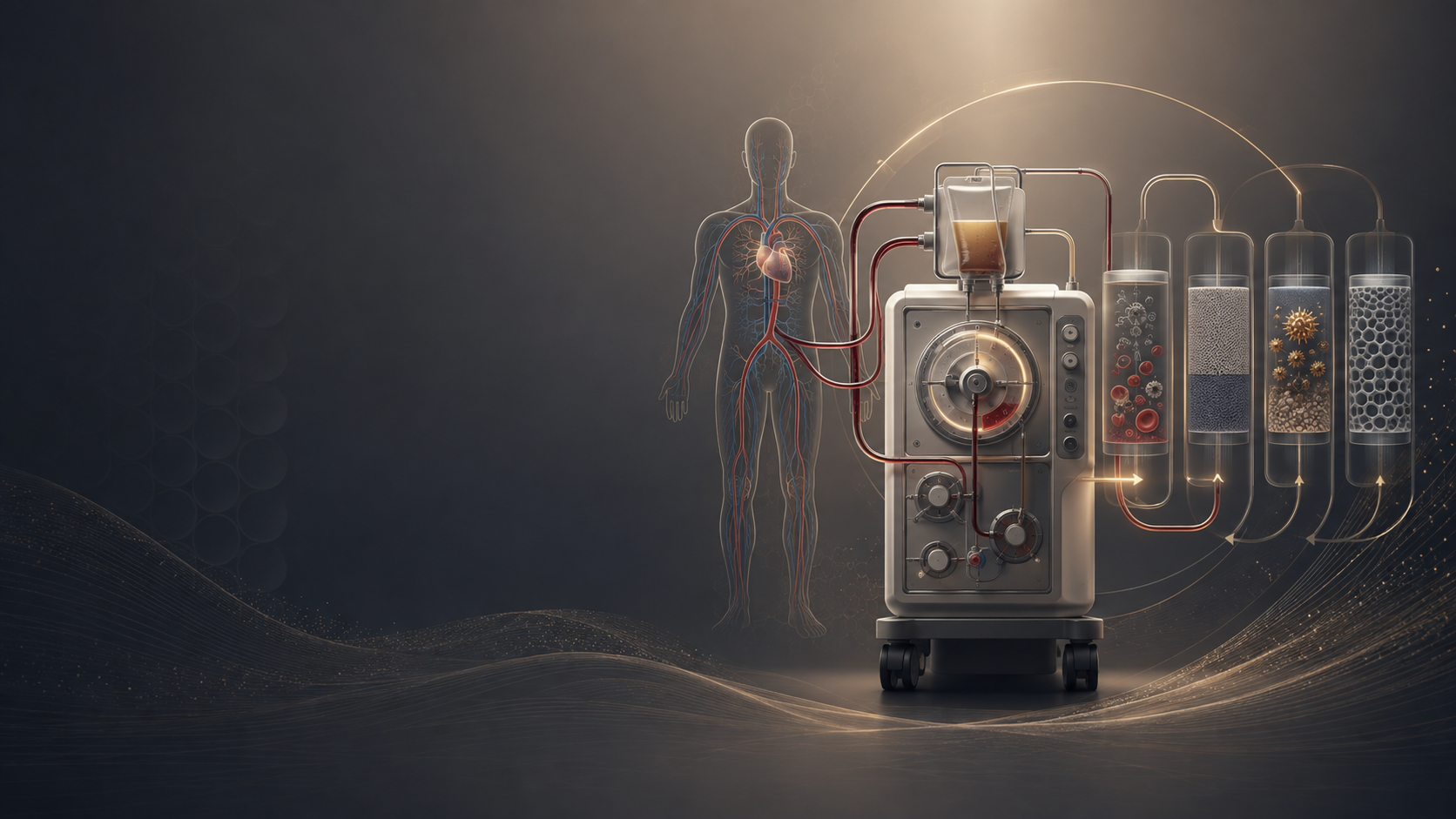






Apheresis⁺ Excellence

At Elysium Institut, we offer full-spectrum blood purification —encompassing over 20 forms of apheresis, hemoperfusion, and hemoadsorption.Each protocol is enhanced with precision diagnostics and targeted regenerativetherapies, forming a structured system rather than a standalone treatment.


Contact concierge

Elysium Institut

Frequently asked questions
Is apheresis a clinically established treatment, or is it experimental?

Apheresis is clinically established, though its evidence strength varies by condition. The American Society for Apheresis (ASFA) 2023 guidelines cover 166 graded indications across 91 disease categories, ranking each by how strong the supporting evidence is. Some uses — such as first-line treatment for specific neurological and autoimmune conditions — are backed by high-quality evidence. Others, including several longevity and performance-related applications, fall into lower evidence categories, meaning they're recognised and used clinically, but the optimal role is still being defined. At Elysium, we're transparent about where each protocol sits: established for defined indications, and appropriately positioned as promising-but-emerging where the evidence is still developing.

What is lipid apheresis and can it lower lipoprotein(a)?

Lipid (lipoprotein) apheresis selectively removes LDL cholesterol and lipoprotein(a), lowering both by 60–70% per session — and it's the only therapy that reduces Lp(a) specifically by 70–80%. A 5-year prospective registry of 170 patients found this treatment dropped major cardiac event rates from 0.41 to 0.06 per year, and a separate longitudinal cohort study found lipid apheresis reduced myocardial infarction frequency by 97%. Candidacy is a medical decision based on Lp(a), cardiovascular history and prior drug response.

How safe are apheresis-based treatments, based on clinical data?

Apheresis has a strong overall safety record when performed under medical supervision. In a multinational registry, adverse events were mostly mild — typically related to venous access or transient hypotension — with severe events occurring in only 0.4% of procedures. A separate registry tracking lipoprotein apheresis specifically recorded adverse events in 4.44% of treatments, the large majority of which resolved without complication. At Elysium, every treatment is preceded by medical screening and delivered under continuous physician supervision to manage individual risk factors.

What's the difference between apheresis, blood purification, and dialysis?

These terms describe a hierarchy, not four separate things. Blood purification is the broadest umbrella term — any method of treating the blood outside the body to remove unwanted substances. Apheresis is a category within that umbrella: it specifically separates blood into its components (plasma, red cells, white cells, platelets) and processes one of them, before returning the rest to the body. Plasmapheresis is a type of apheresis that targets the plasma specifically — separating it from the blood cells so it can be filtered, modified, or replaced. Plasma exchange is a specific technique within plasmapheresis, where the separated plasma is removed entirely and replaced with a substitute fluid, rather than filtered and returned. In practice, the terms are often used loosely and interchangeably in casual conversation, but clinically each describes a more specific step within the same overall process. At Elysium, the specific technique used — whether plasma exchange, selective filtration, or another apheresis method — depends entirely on what your diagnostics indicate needs to be addressed.

Can apheresis help with cholesterol that doesn't respond to statins?

Yes, this is one of the most well-established uses of apheresis. Lipid apheresis is specifically indicated when statins and other lipid-lowering medication fail to bring LDL cholesterol and lipoprotein(a) to target levels, including in familial hypercholesterolaemia and statin-intolerant patients. It lowers both LDL-C and Lp(a) by 60–70% per session — a reduction no oral therapy can match. Candidacy is a medical decision based on your lipid profile, cardiovascular history, and how you've responded to medication so far.

Can apheresis help with autoimmune conditions like myasthenia gravis or Guillain-Barré syndrome?

Yes, these are among the strongest-evidenced uses of apheresis in medicine. Both myasthenia gravis and Guillain-Barré syndrome are classified as Category I indications by the American Society for Apheresis (ASFA), meaning apheresis is accepted as first-line therapy, either alone or alongside other treatment. In these conditions, the immune system produces antibodies that attack the body's own neuromuscular tissue; therapeutic plasma exchange removes these antibodies directly from circulation, often producing meaningful improvement during acute episodes. This is a different clinical context from longevity-focused apheresis — it reflects apheresis's original, most rigorously proven use in acute autoimmune and neurological disease.

Can apheresis help lower the risk of a heart attack in people who've already had one?

There's meaningful evidence for this in patients with elevated lipoprotein(a). A longitudinal cohort study found that lipid apheresis reduced the frequency of myocardial infarction by 97%, regardless of a patient's LDL cholesterol levels before treatment. Separately, a 5-year prospective registry of 170 patients on regular lipid apheresis found major cardiac event rates dropped from 0.41 to 0.06 per year once treatment began. This evidence specifically applies to patients with elevated Lp(a) and progressive cardiovascular disease — not a general population — and candidacy depends on your individual risk profile and prior cardiac history.

Apheresis⁺

Chronic conditions and performance limitations are rarely caused by asingle factor. They result from complex interactions between the immune system,metabolism, vascular integrity, and cellular energy production.

Apheresis⁺ reflects this complexity. It is not a single intervention,but a structured, patient-centred system — built to address what burdens thebody, restore function, and support long-term stability.

Every pathway follows the same model:

Diagnostics → Intervention → Stabilization → Optimization

And every pathway is:

  • Individually designed
  • Continuously monitored
  • Dynamically adapted

Nothing at Elysium follows a fixed protocol. Diagnostics, therapy, andfollow-up are coordinated within one system — focused on measurable progress,not a one-time procedure.

Apheresis⁺ is designed for those who:
  • Are managing a chronic condition that hasn'tresponded to conventional treatment alone
  • Want to address the root biological drivers offatigue, inflammation, or metabolic imbalance — not just the symptoms
  • Value a diagnostics-led, personalized approachover a fixed, one-size-fits-all protocol
Explore Treatments:
Therapeutic Plasmapheresis

Selective plasma filtration, modulation or adsorption to remove inflammatory mediators, toxins, autoantibodies and more from the bloodstream.

Stempheresis®

Therapeutic apheresis combined with autologous pluripotent embryonic-like stem cell therapy

Adaptive Detox Apheresis®

Broad-spectrum blood filtration removing environmental toxins, heavy metals, microplastics, and inflammatory mediators.

EBOOpheresis®

The first EBOO (exctracorporeal oxygenation and ozonation) treatment utilising state of the art plasmapheresis technology

aTPE - Advanced Therapeutic Plasma Exchange®

An apheresis modality designed to remove pathological plasma components and restore systemic balance.

Apheresis Enhancements

Apheresis Enhancements - a curated set of therapy add-ons enhancing apheresis by improving circulation, detoxification, oxygen delivery, and cellular responsiveness.

Liverpheresis

A specialized apheresis therapy utilizing targeted bilirubin adsorption to support liver function and systemic detoxification.

Lipid Apheresis

A specialized apheresis therapy designed to selectively remove atherogenic lipids and improve vascular health.

Immunoadsorption

A precision apheresis technique designed to selectively remove antibodies for targeted immune modulation.

Oxypheresis®

An advanced therapy combining intravenous oxygenation with apheresis to enhance oxygen availability, detoxification, and systemic performance.

Hyperpheresis®

A synergistic therapy combining hyperbaric oxygen therapy with apheresis to enhance oxygen delivery, detoxification, and cellular regeneration.

Thermopheresis®

A synergistic therapy combining controlled hyperthermia with apheresis to enhance detoxification, circulation, and systemic regeneration.

Hemoadsorption

A highly selective full blood apheresis modality utilizing advanced adsorption membranes to remove pathogenic proteins, toxins, and inflammatory mediators.

Hemoperfusion

A targeted full blood purification therapy utilizing adsorption technology to remove toxins, inflammatory mediators, and metabolic waste directly from circulation.

Contact our Concierge

Modern medicine is moving beyond isolated interventions. Apheresis⁺ isbuilt on that same principle — not only removing what burdens the body, butrestoring function and building a stable foundation for continuous health.

Close